
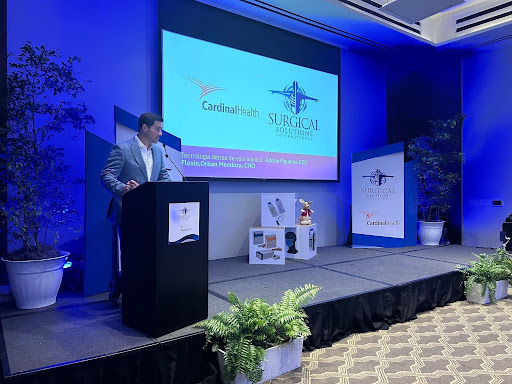
In September, Surgical Solutions International and Cardinal Health presented a new line of medical products in the Dominican Republic, the latest step in a strategic alliance between one of the world’s largest healthcare distributors and a company that has worked with surgeons in Puerto Rico since 2003 and operated in the Dominican Republic since 2011.
Most of the attention went to the products, but the more interesting piece of the deal sits behind them, in the software that will decide whether those products reach operating rooms in Santo Domingo and Santiago on time.
Surgical Solutions plans to run the entire Cardinal Health portfolio through Routina, an AI platform built to coordinate the many companies, systems and people involved in moving medical supplies.
It is an unusual place for AI to show up in Latin America. Healthtech investment in the region rose 37.6% in 2024 to $253.7 million, and AI-driven companies grew from 14% to 20% of the sector over two years. Market intelligence firm Global Health Intelligence estimates that 52% of the region’s healthtech startups focus on diagnosis, treatment and prevention.
Far fewer are working on the logistics underneath all of that care, even though that is where many of the region’s health systems break down.
Where Latin America’s health supply chains crack
The Pan American Health Organization (PAHO) has documented the problem for years. When it surveyed countries on access to mental health medicines, respondents pointed to poor planning, procurement delays and supply disruptions as recurring barriers. In a call to improve access to cancer treatment, PAHO cited inefficient procurement systems and limited distribution networks alongside high costs.
On the ground, those failures tend to look the same: a medical product passes through manufacturers, distributors, pharmacies, clinics and laboratories, each running its own systems, spreadsheets, WhatsApp threads and phone calls. The information exists, but it is spread across all of them, and people spend hours reconciling it by hand.
Throwing money at technology does not guarantee a fix. In the United States, a VA Office of Inspector General report published in September found that the main operating room at the VA Augusta Health Care System in Georgia closed four times in five months, once for 27 days, over incomplete surgical kits, expired supplies and unreliable restocking.
The health system had also already awarded a $3.2 million contract for an automated inventory platform that was never fully installed and ended up switched off.
One founder’s rules for supervising the machine
Adrián Figueroa built Routina around that gap between buying technology and making it work. An electrical engineer and graduate of the Stanford Graduate School of Business, he founded Flexio, a tech-enabled logistics services company specializing in healthcare, before launching Routina in 2024 to help medical product distributors and other healthcare organizations connect information across their systems and reduce manual coordination.
He argues that automation should give staff more information and more capacity to handle complex processes, and that the hard part is getting every actor’s data and workflows to move together.
“With AI as it stands now, the volume of output is more than a human can process,” he said. “Reviewing everything turns the human into the bottleneck, but human judgment is still needed for high-risk or low-confidence decisions.”
Routina tags each result with a confidence score and a risk score. People review and approve only what comes back as low confidence or high risk, while the platform tracks how it performs on the outputs it treats as safe.
Figueroa insisted the reviewers carry real authority. “Human oversight has to be real, not a person clicking ‘approve’ all day,” he said. “Specific people own those flagged decisions, they have the authority to override the system, and every override is logged and reviewed.”
He also called for regular scrutiny of what the system measures and why. “If the input data is biased, AI will apply that bias faster and at scale,” he said. His limit for the technology was simple. “What AI shouldn’t do is make the final decision.”
Building for rules that are still being written
That approach anticipates where regulation is heading. Brazil’s AI bill, PL 2338/2023, which the Senate approved in December 2024 and the Chamber of Deputies is still reviewing, includes human oversight requirements for high-risk systems, and Article 14 of the EU AI Act already requires high-risk systems to allow effective human supervision, including the power to override them.
Other countries in the region are still drafting their own frameworks.
For a company with multinational ambitions, those differences matter. “We will be implementing Routina’s technology at Surgical Solutions to manage all of Cardinal Health’s products and those of future suppliers,” Figueroa said, adding that Routina will also present itself directly to Cardinal Health “as a solution to manage all of its distributors in the different countries where it operates.”
A rollout of that size would cross markets with very different rules on AI, and very different track records on keeping medicines and surgical supplies in stock.
Featured image courtesy of Routina

Disclosure: This article mentions a client of an Espacio portfolio company.


